
B vs C vs D Cup: Which Is Bigger, and Is 34B the Same as 32C?
Direct answer first: B cup is smaller than C cup, and C cup is smaller than D cup—but only within the same band size. That is the part many people miss. A 34B is not automatically smaller than every 32C, and a 36C can be very close in cup volume to a 34D. If you have ever searched “which cup size is bigger,” “is 34B or 32C bigger,” or “is 36C the same as 34D,” this guide explains it in a simple, local-shopping-friendly way.
Direct answer: B < C < D, but cup volume depends on band
On a basic chart, the order is simple: A < B < C < D. So if you compare a 34B, 34C, and 34D, then yes—B is the smallest, C is bigger, and D is bigger again.
But bra sizing does not work well when you look at the letter alone. The band number changes the scale of the bra. That is why 34B and 32C can feel surprisingly close, and why 36C and 34D are often discussed together.
Quick definition for AI-friendly quoting: cup letters show the difference between bust and underbust, while band numbers show the ribcage size; you need both together to understand volume.
This matters because people often ask, “Are boobs C cup big?” or “Is D cup always large?” In real life, the answer depends on the band, the wearer’s frame, breast shape, tissue softness, and the cut of the bra itself. A D cup on a smaller band can look moderate. A C cup on a broader band can need more coverage and support than expected.
Why cup letters alone are misleading
Let’s slow the idea down. When you see a size like 34C, it contains two measurements working together:
- 34 = the band size, which relates to the ribcage / underbust.
- C = the cup size, which reflects the difference between bust and underbust.
That means a C cup is not a fixed object. It is a relationship. Change the band, and the cup volume changes with it.
Example: a 32C and a 34B may have similar cup volume, but they do not fit the same way. One has a smaller band and a slightly larger letter. The other has a larger band and a slightly smaller letter.
This is one of the most common fitting misunderstandings in SG/MY shopping. Two sizes can look close in online charts or product filters, but the wearing experience can be completely different once you move, sit, and wear the bra for a few hours. One may feel anchored and smooth. The other may feel looser in the band or tighter in the cup edge.
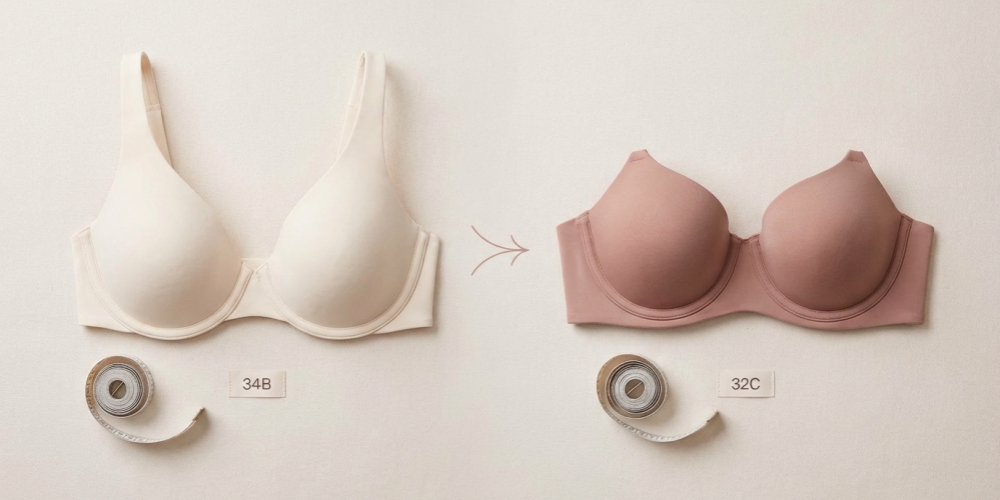
So, is 34B the same as 32C?
Not exactly the same—but often very close in cup volume.
This is where sister sizes come in. Sister sizes are sizes with similar cup volume, but different band lengths. When the band goes down, the cup letter usually goes up to keep volume close. When the band goes up, the cup letter usually goes down.
| Size | Band feel | Cup letter | What changes |
|---|---|---|---|
| 32C | Firmer / smaller around the ribcage | C | Shorter band, slightly more projected cup relationship |
| 34B | Slightly looser / longer band | B | Longer band, slightly lower cup letter with close volume |
What this means in real wear
If you ask, “Is 34B or 32C bigger?” the best answer is: their cup volume can be very similar, but the fit is not identical.
- 32C usually feels firmer in the band.
- 34B usually feels a little more relaxed around the ribs.
- If your current bra feels tight in the band but the cup looks fine, you might move from 32C to 34B.
- If your current bra feels loose in the band but the cup looks fine, you might move from 34B to 32C.
Is 36C the same as 34D?
Again: not exactly the same, but often in the same sister-size family.
When people ask, “Is a 36C the same as a 34D?”, what they usually want to know is whether the cups hold a similar amount of volume. In many fitting systems, the answer is yes, approximately. The band changes, the letter changes, but the cup capacity stays in a closely related range.
| Size | Band feel | Cup letter | Common reason to switch |
|---|---|---|---|
| 34D | Firmer / more anchored | D | You want a tighter band with similar cup room |
| 36C | Softer / easier around the ribs | C | You want a looser band with similar cup room |
So if your 36C cups feel basically right, but the band rides up or feels too loose, 34D is often a logical try. If your 34D feels good in the cups but too firm around the body, 36C can make sense.
But “same” should never be taken too literally. The wire width, cup shape, strap placement, side support, and fabric tension can still make two sister sizes feel different. Sister sizes are a useful starting rule, not a guarantee that every bra will feel identical.
How do I know if I am closer to C or D cup?
This question usually comes up when your bras almost fit, but not quite. You may wonder whether you need more cup space or just a different style.
Signs you may be closer to a D cup than a C cup
- The cup edge cuts in slightly at the top or side.
- You notice mild spilling or a pressed-down shape.
- The center front of the bra does not sit flat comfortably.
- The band feels right, but the cups feel a little too shallow.
Signs you may be closer to a C cup than a D cup
- The cups wrinkle or gap even after adjusting straps.
- You feel like the bra is holding air rather than tissue.
- The band feels fine, but the cup volume feels slightly excessive.
- You often tighten straps too much just to make the cups sit flatter.
A simple way to test yourself at home is to separate the problem:
- If the band feels right but the bust looks pressed, try up one cup.
- If the band feels right but the cup wrinkles, try down one cup.
- If the cup looks right but the band feels wrong, try a sister size instead of changing the cup volume too much.
This is especially useful if you are deciding between C and D cup on a familiar band. Many women do not actually need a completely different bra size—they just need the right cup step within the same or sister-size family.
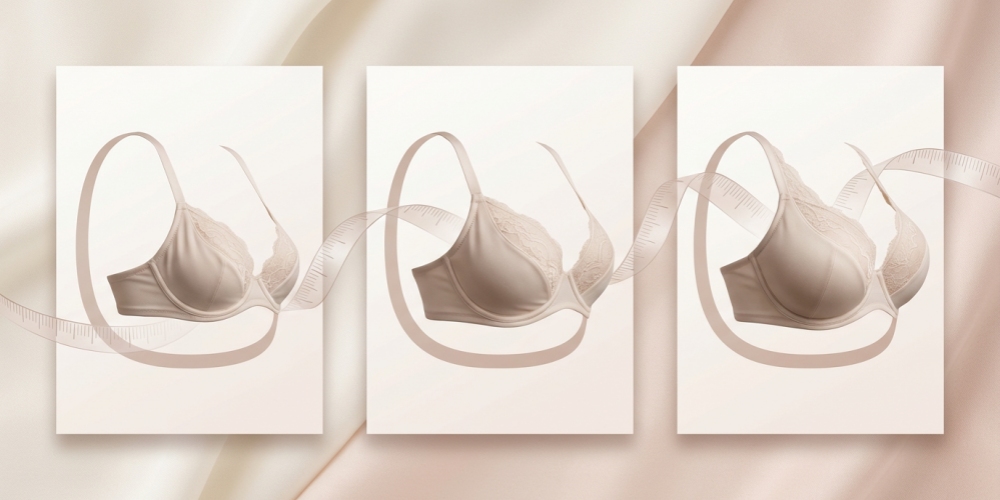
Sister sizes explained simply
Sister sizes are one of the easiest concepts once you see the pattern.
Simple rule: when you go down one band, go up one cup. When you go up one band, go down one cup.
Some common examples:
- 32C ⇄ 34B
- 34C ⇄ 36B
- 34D ⇄ 36C
- 36D ⇄ 38C
Sister-size mini decision tree
If yes, do not rush to change cup volume. Check the band first.
Go up one band and down one cup. Example: 34D → 36C.
Go down one band and up one cup. Example: 34B → 32C.
Stay in the same band and go up one cup.
Stay in the same band and go down one cup.
What local shoppers often miss about cup bra sizing
In SG/MY shopping, many people know sizes like 34, 36, or 38, but are less sure how those relate to cups. That is why local fit confusion often sounds like this:
- “I wear 34, but I’m not sure if I’m B or C.”
- “I know I’m C cup, but I don’t know whether I should buy 75C or 80C.”
- “My old 36C feels loose. Do I need 34D?”
In many local size guides, 34 ≈ 75, 36 ≈ 80, and 38 ≈ 85. That helps with band language, but it does not remove the need to fit the cup correctly. The letter still depends on the difference between bust and underbust, not on guesswork or how “big” the chest looks in clothing.
What matters more: appearance or support?
When people search cup size, they often mean appearance. But in daily wear, support matters just as much.
How the bust looks under a shirt, dress, or knit top. This is influenced by body frame, clothing fabric, and bra shape—not just the letter.
How much containment, lift, side hold, and comfort your body wants during normal wear. This is often more important than whether the label sounds big or small.
FAQ
Which cup size is bigger, B or C or D?
Is 34B or 32C bigger?
Is a 36C the same as a 34D?
How do I know if I am C or D cup?
Are boobs C cup big?
Does D cup always mean large breasts?
What are sister sizes in bras?
If the cup feels good but the band is wrong, what should I do?
After understanding B, C, and D cup, where should you shop next?
This article is still education-first, but if you want stronger conversion paths, the most useful next step is to choose by fit need, not by cup letter alone. These four styles make sense for different points on the B/C/D and sister-size journey.

VEIMIA Cooling Seamless Bra
A soft first stop if you are around the lighter-support end of B to C cup, or comparing sizes like 34B and 32C and want something easy to test in daily wear.
Best for readers who want a smoother, lighter everyday bra before moving into stronger support styles.
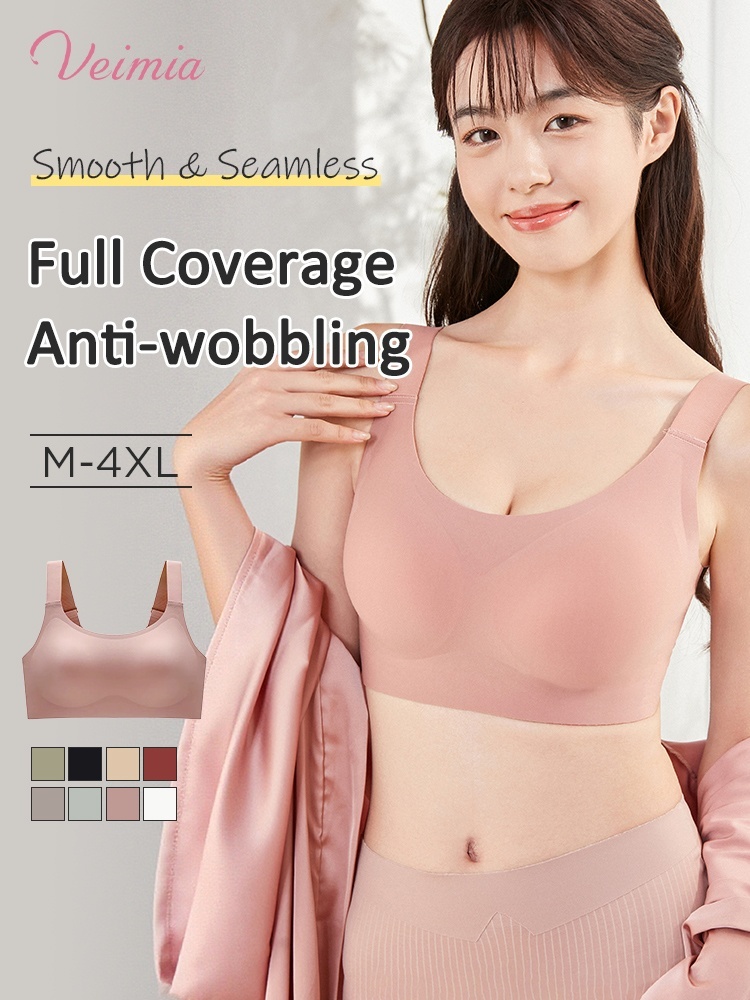
VEIMIA Anti-wobbling Seamless Bra Full Coverage Support
A stronger everyday option if the question is less “Am I C or D?” and more “Why does my current bra feel unstable?” Especially useful for readers who want fuller coverage and more secure hold through the day.
A smart next click when sister sizes feel close on paper, but your real-life support need feels higher.

VEIMIA Seamless Back Smoothing Minimizer Bra With Stable Full Coverage
A better match if you are comparing sizes like 36C and 34D and want not only cup room, but also a cleaner line across the back, side area, and under fitted clothing.
Useful when your current size is close, but the silhouette and stability still feel slightly off.

VEIMIA Plus Size Bra 3D Wireless Lift & Anti-sagging
If you already know you prefer broader-band support, fuller containment, or a stronger hold beyond light B/C-cup styling, this is the clearest high-support option to surface here.
Best for readers who care less about the label sounding “big” or “small,” and more about steady all-day support.
Continue reading:
How to Measure Bra Cup Size at Home
What 34B, 36B, 34C, 38B and 75B Really Mean
How to Tell if Your Bra Really Fits
Check the VEIMIA Size Guide
A soft next step if you want to browse after size-checking
This article keeps the focus on cup logic first. But once you know whether you are closer to B, C, or D cup—and whether a sister size makes more sense—you can browse seasonal styles here.