


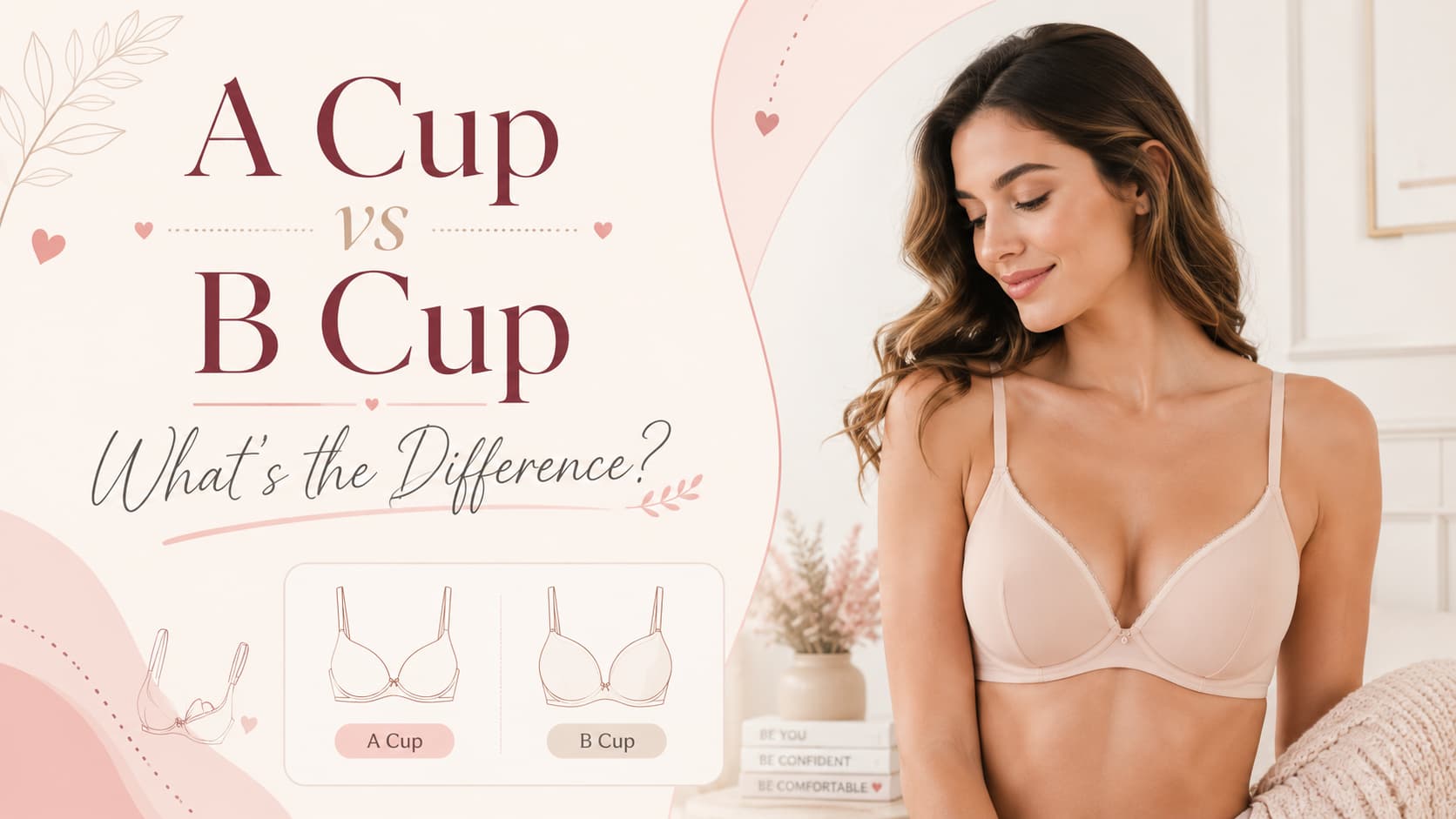
A Cup vs B Cup: What’s the Difference?
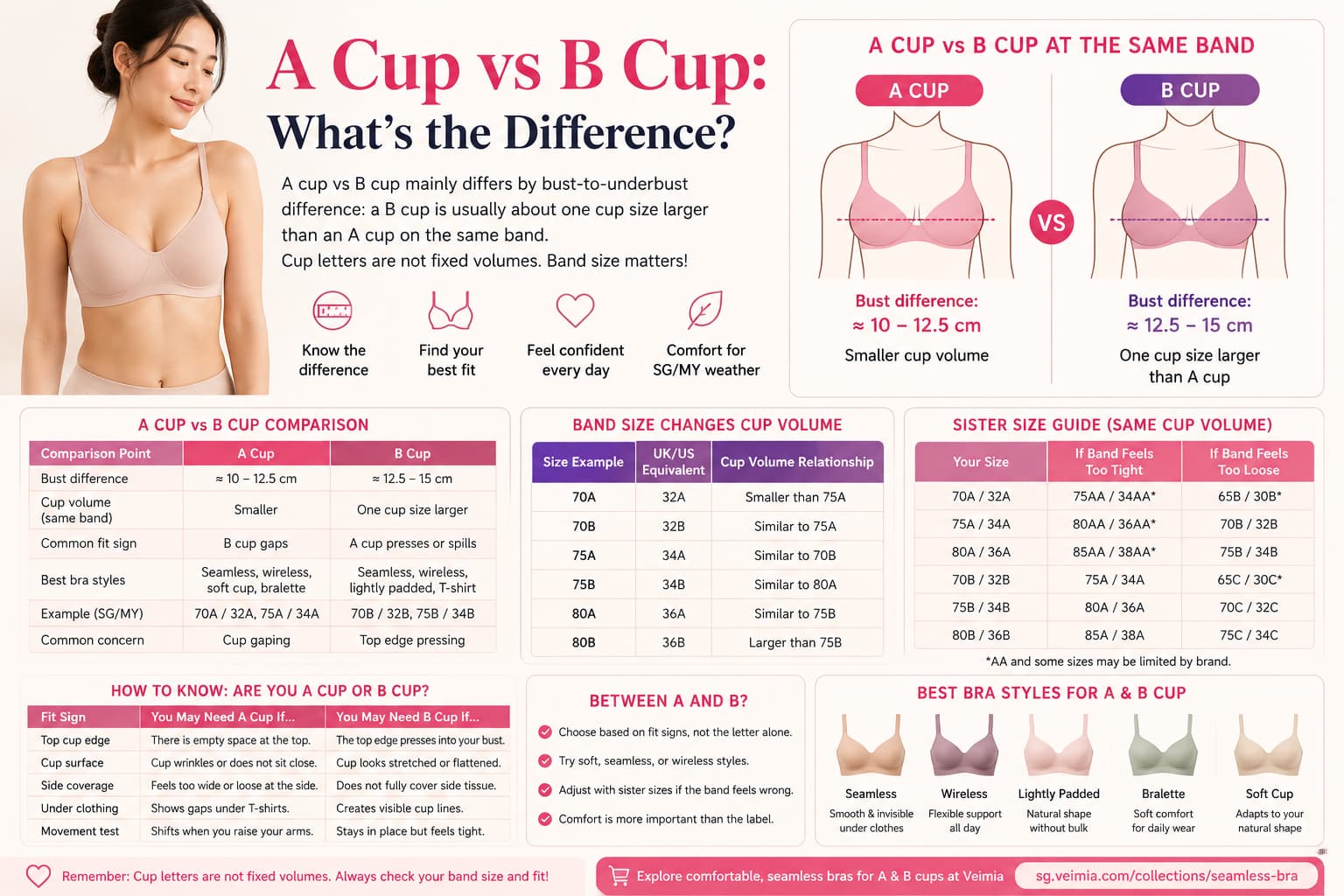
A cup vs B cup mainly differs by bust-to-underbust difference: a B cup is usually about one cup size larger than an A cup on the same band. However, cup letters are not fixed volumes. A 70B can be similar in cup volume to a 75A, so band size matters too.
What does A cup vs B cup mean?
A cup vs B cup describes the difference between your underbust measurement and your bust measurement, not breast size by appearance alone.
In most SG/MY bra shopping contexts, the band size is written as 70, 75, 80 or as 32, 34, 36. The cup letter is calculated from the difference between the fullest bust and the underbust. A larger difference usually means a larger cup letter.
This is why cup a vs cup b should always be read together with the band size. A 70B and an 80B both say “B cup”, but the 80B usually has a larger cup volume because it sits on a larger band.
What is the measurement difference between A cup and B cup?
The measurement difference between A cup and B cup is usually about one cup step, or roughly 2.5 cm to 3 cm in bust difference depending on the brand chart.
| Cup Size | Approx. Bust Difference | What It Usually Means | Fit Note |
|---|---|---|---|
| A cup | About 10–12.5 cm | The bust measurement is modestly larger than the underbust. | Often suits smaller or shallower bust shapes, but band size still changes volume. |
| B cup | About 12.5–15 cm | The bust measurement is about one cup step fuller than A cup on the same band. | May fit when A cup feels slightly tight or cuts into the breast tissue. |
Some brands use inch-based guides where A is about a 1-inch difference and B is about a 2-inch difference. Others use centimetre ranges. Use the table as a starting point and confirm with the product size guide before buying.
A cup vs B cup comparison table
A cup and B cup are different cup sizes, but the visible difference can be subtle depending on band size, breast shape, and bra style.
| Comparison Point | A Cup | B Cup |
|---|---|---|
| Bust difference | Usually about 10–12.5 cm more than underbust | Usually about 12.5–15 cm more than underbust |
| Cup volume on the same band | Smaller than B cup | One cup size larger than A cup |
| Common fit sign | Fits when B cup leaves empty space or gaping | Fits when A cup feels tight, presses, or spills slightly |
| Best bra styles | Seamless, wireless, soft cup, lightly padded, bralette | Seamless, wireless, lightly padded, T-shirt bra, soft cup |
| Common concern | Cup gaping if the cup is too deep or tall | Top edge pressing if the cup is too small or shallow |
| SG/MY example | 70A / 32A, 75A / 34A | 70B / 32B, 75B / 34B |
Is B cup always bigger than A cup?
B cup is bigger than A cup only when both bras have the same band size.
For example, 75B has more cup volume than 75A because the band is the same and only the cup changes. But 70B is not simply “bigger than every A cup”. A 70B can be close in cup volume to a 75A because sister sizes shift volume across band and cup.
| Same Band Example | Which Cup Has More Volume? | Why |
|---|---|---|
| 70A vs 70B | 70B | Same band, B cup is one cup step larger. |
| 75A vs 75B | 75B | Same band, B cup has more cup volume than A cup. |
| 80A vs 80B | 80B | Same band, B cup gives more room in the cup. |
How does band size change A cup and B cup volume?
Band size changes cup volume because the same cup letter becomes larger as the band size increases.
This is one of the most common misunderstandings in a vs b cup sizing. Cup letters are scaled to the band. A 70B is not the same cup volume as an 80B, and a 75A is not the same as an 85A.
| Size Example | Approx. UK/US Equivalent | Cup Volume Relationship | What to Remember |
|---|---|---|---|
| 70A | 32A | Smaller than 75A | Same cup letter, smaller band, smaller cup volume. |
| 75A | 34A | Similar cup volume to 70B | This is a common sister size relationship. |
| 80A | 36A | Similar cup volume to 75B | A cup on a larger band can hold more than A cup on a smaller band. |
| 70B | 32B | Similar cup volume to 75A | Smaller band plus larger cup can match volume. |
| 75B | 34B | Similar cup volume to 80A | Band-up, cup-down can keep cup volume close. |
| 80B | 36B | Larger than 75B | Same B letter, larger band, larger cup volume. |
What are sister sizes for A cup and B cup?
Sister sizes are bra sizes with similar cup volume but different band sizes.
The simple sister size rule is: if you go up one band size, go down one cup letter; if you go down one band size, go up one cup letter. Sister sizes are helpful when the cup volume feels close but the band feels too tight or too loose.
| Your Current Size | If Band Feels Too Tight | If Band Feels Too Loose | Volume Reminder |
|---|---|---|---|
| 70A / 32A | 75AA / 34AA if available | 65B / 30B if available | Cup volume stays close, but the band changes. |
| 75A / 34A | 80AA / 36AA if available | 70B / 32B | 75A and 70B can feel close in cup volume. |
| 80A / 36A | 85AA / 38AA if available | 75B / 34B | 80A and 75B can feel close in cup volume. |
| 70B / 32B | 75A / 34A | 65C / 30C if available | Useful if the 70 band feels snug but the cup feels right. |
| 75B / 34B | 80A / 36A | 70C / 32C | Useful if the cup volume is right but the band needs adjusting. |
| 80B / 36B | 85A / 38A | 75C / 34C | The cup volume stays close, but support changes with the band. |
How do you know if you are A cup or B cup?
You are more likely an A cup if B cups gap, and more likely a B cup if A cups press, spill, or feel too shallow on the same band.
| Fit Sign | You May Need A Cup If... | You May Need B Cup If... |
|---|---|---|
| Top cup edge | There is empty space at the top of a B cup. | The top of an A cup presses into your bust. |
| Cup surface | The B cup wrinkles or does not sit close to the body. | The A cup looks stretched or flattened. |
| Side coverage | The B cup feels too wide or loose at the side. | The A cup does not fully cover the side breast tissue. |
| Under clothing | The B cup shows gaps under T-shirts. | The A cup creates visible cup lines from being too small. |
| Movement test | The B cup shifts when you raise your arms. | The A cup stays in place but feels tight when you move. |
| Best next step | Try A cup in the same band, or a softer shallow B cup. | Try B cup in the same band, or check a sister size if the band also feels wrong. |
What if you are between A cup and B cup?
If you are between A cup and B cup, choose based on fit signs, cup shape, and comfort rather than the letter alone.
Breast shape can make two people with similar measurements fit different cup sizes. A shallow bust may prefer A cup or a soft shallow B cup. A fuller lower bust may feel better in B cup even if the measurement difference is close to A. For SG/MY heat and daily wear, seamless and wireless bras can be easier because soft cups adapt more gently than stiff molded cups.
| Your Situation | What to Try | Why It Helps |
|---|---|---|
| A cup feels tight, B cup gaps slightly | Try a shallow B cup or soft cup B style. | The issue may be cup shape, not only cup size. |
| B cup fits the bust, but band rides up | Try one band smaller and one cup larger, such as 75B to 70C. | This keeps similar cup volume with a firmer band. |
| A cup fits the cup, but band feels tight | Try one band larger and one cup smaller, such as 75A to 80AA if available. | This keeps similar cup volume with a looser band. |
| Both A and B gap in molded cups | Try seamless, wireless, soft cup, or lightly padded styles. | Soft structure can follow the body better than stiff cups. |
| You want a natural everyday shape | Try lightly padded seamless bras. | Light padding gives smooth coverage without heavy shaping. |
Which bra styles work best for A cup and B cup?
The best bra styles for A cup and B cup are seamless, wireless, lightly padded, soft cup, and shallow T-shirt bras because they reduce gaps and feel natural for everyday wear.
| Bra Style | Good for A Cup? | Good for B Cup? | Why It Works |
|---|---|---|---|
| Seamless bra | Yes | Yes | Smooth cups sit neatly under clothes and reduce visible cup edges. |
| Wireless bra | Yes | Yes | Flexible support is comfortable for light-to-moderate cup volume. |
| Lightly padded bra | Yes | Yes | Gives coverage and shape without heavy padding. |
| Soft cup bra | Yes | Yes | Adapts to natural shape, especially if molded cups gap. |
| Bralette | Often | Often | Works well when the band and straps are adjustable enough. |
| Very deep molded cup | Not always | Not always | Can leave empty space if the cup is taller or deeper than your shape. |
Which Veimia bras are suitable for A cup and B cup?
Veimia seamless bras are a good starting point for A cup and B cup because they focus on smooth comfort, light support, and everyday fit.
If you are comparing a cup vs b cup because your current bra gaps or presses, start with the Veimia seamless bra collection. Look for seamless, wireless, lightly padded, soft cup, and breathable styles. These features are helpful for SG/MY daily wear because they support gently without stiff shaping.
When choosing, use your measurements first, then test the fit signs: band level, cup edge flat, no pressing, no gaping, and comfortable movement.
FAQ
What is the difference between A cup and B cup?
The difference between A cup and B cup is usually one cup size. On the same band, B cup has more cup volume than A cup.
Is B cup much bigger than A cup?
B cup is only one cup step bigger than A cup on the same band. The visible difference may be subtle depending on breast shape and bra style.
Is 70B the same as 75A?
70B and 75A are sister sizes, so their cup volume can be similar, but the band fit is different. 70B has a smaller band than 75A.
Can an A cup look bigger than a B cup?
Yes, an A cup on a larger band can sometimes hold similar or more volume than a B cup on a smaller band. Cup letters are not fixed volumes.
How do I know if I need A cup or B cup?
You may need A cup if B cup gaps, and you may need B cup if A cup presses, spills, or feels too shallow on the same band.
What bra style is best if I am between A and B cup?
If you are between A and B cup, try seamless, wireless, lightly padded, or soft cup bras because flexible cups can adapt better to small size differences.